A stopping rule is more useful than a prediction score.
Responsible play starts before a ticket is purchased: decide the entertainment budget, frequency and conditions that end the session.
Define the system before judging the result
Responsible play starts before a ticket is purchased: decide the entertainment budget, frequency and conditions that end the session. A useful definition names what is inside the decision, what remains outside it and which entity owns each attribute. Without that boundary, words such as “accurate,” “accessible,” “large,” “safe” or “high capacity” can quietly change meaning between the claim and the conclusion.
The framework on this page separates an observation from an inference and an inference from an action. That distinction matters because a plausible story can still be unsupported. Record the source, date and scope of each input; identify which value would change the decision; and keep unknowns visible. When a result depends on a current price, rule, business status, weather event or site condition, verify it again at the moment of use. The goal is not perfect certainty. It is a decision that another reader can reconstruct, challenge and update without relying on confidence language.
- Entertainment budget
- Money set aside after essential costs, savings and obligations, with no expectation of recovery.
- Loss chasing
- Increasing spend or urgency in an attempt to recover previous losses.
- Precommitment
- A limit decided while calm and applied before the emotionally charged outcome occurs.
- Self-exclusion
- A formal tool offered in many jurisdictions to restrict access to gambling products for a chosen period.
Use an EAV decision framework
Entity–attribute–value thinking turns a vague topic into checkable fields. The entity is the thing being evaluated; the attribute is the property that matters; the value is the measured, quoted or observed state. Keep units, dates and sources attached to values. The table below is a working decision framework rather than a list of generic tips.
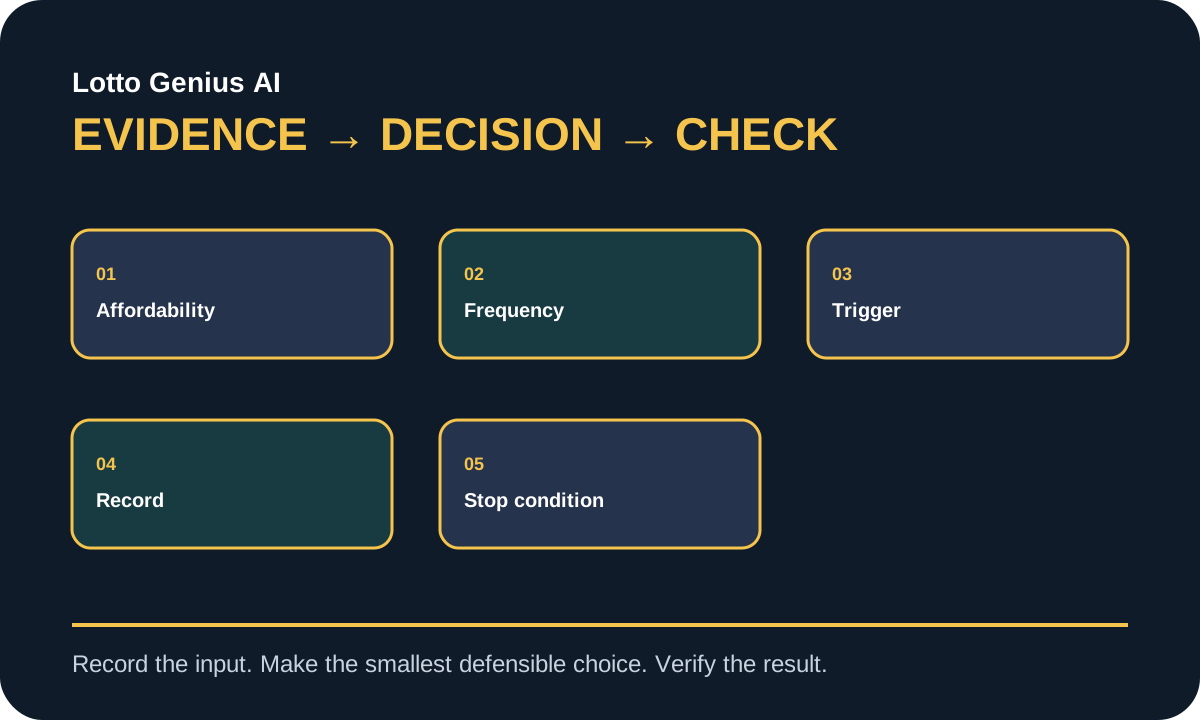
| Variable | Evidence to collect | Decision rule |
|---|---|---|
| Affordability | Does the spend compete with essentials or debt payments? | If yes, the entertainment budget is zero. |
| Frequency | How often will purchases occur? | Use a written schedule rather than prompts or streaks. |
| Trigger | What situation causes extra spending? | Block impulse purchases after wins and losses. |
| Record | Can total spend and return be seen in one place? | Review net figures, not isolated prizes. |
| Stop condition | Which signal ends play? | Choose time, money and emotional conditions in advance. |
Run the workflow in order
Use the sequence below as a small operating procedure. Each step creates evidence for the next, and the final step checks whether the original problem changed. Do not skip directly from a symptom or marketing claim to a purchase. If a required input is unavailable, label the choice provisional and prefer a reversible action. A written sequence also prevents hindsight from rewriting why the decision was made.
- Choose a fixed entertainment amount only after rent, food, health, debt and savings commitments are covered. After completing it, save the supporting note, measurement or confirmation so the next step does not depend on memory.
- Set purchase frequency and disable marketing notifications that invite unplanned entries or suggest urgency. After completing it, save the supporting note, measurement or confirmation so the next step does not depend on memory.
- Record every ticket, subscription fee and payout in the same ledger so gross wins cannot hide net loss. After completing it, save the supporting note, measurement or confirmation so the next step does not depend on memory.
- Stop when the budget, time limit or emotional condition is reached; do not let a model confidence score override the rule. After completing it, save the supporting note, measurement or confirmation so the next step does not depend on memory.
- If play becomes secretive, borrowed, distressing or difficult to stop, pause access and contact a qualified local support service. After completing it, save the supporting note, measurement or confirmation so the next step does not depend on memory.
Work through a bounded example
A dashboard labels the next draw a “high confidence opportunity.” The weekly entertainment limit has already been spent. The precommitted decision is therefore simple: no additional ticket is bought. The label does not change the game rules or personal budget. The user records the prompt as a trigger, disables notifications and reviews whether the tool is supporting entertainment or creating pressure. If control feels difficult, the next step is outside the prediction system: account limits, self-exclusion or professional support. This worked example is deliberately bounded: it does not prove that the same answer applies to every property, game, traveler or roof. It demonstrates how entities and attributes become a decision record. A strong record includes the competing options, the limiting constraint, the evidence used, the action taken and the observation that would trigger a revision.
Decision record: write the initial claim, evidence date, limiting constraint, selected action, expected observation and review date in one place. This compact record makes later updates honest and makes the method teachable.
Check predictable failure modes
Most bad outcomes begin with a missing denominator, an unverified current fact, a hidden constraint or a comparison between unequal options. Review these failure modes before the decision becomes expensive or difficult to reverse.
- Failure mode: Increasing spend after a near miss because the result feels like evidence of progress. The repair is to return to the missing input, make it observable and compare the revised choice with the original baseline.
- Failure mode: Using borrowed money or delaying essential payments to preserve a betting routine. The repair is to return to the missing input, make it observable and compare the revised choice with the original baseline.
- Failure mode: Counting small prizes as new budget without recording the original stake. The repair is to return to the missing input, make it observable and compare the revised choice with the original baseline.
- Failure mode: Allowing alerts, streak labels or limited-time language to override a written stop condition. The repair is to return to the missing input, make it observable and compare the revised choice with the original baseline.
Verify with primary or authoritative sources
The framework on this page separates an observation from an inference and an inference from an action. That distinction matters because a plausible story can still be unsupported. Record the source, date and scope of each input; identify which value would change the decision; and keep unknowns visible. When a result depends on a current price, rule, business status, weather event or site condition, verify it again at the moment of use. The goal is not perfect certainty. It is a decision that another reader can reconstruct, challenge and update without relying on confidence language. Editorial review on this site favors official rules, government guidance, standards bodies and clearly identified primary documentation. A source supports only the claim it actually addresses; it does not transfer authority to unrelated conclusions.
- National Council on Problem Gambling — consult the current version and jurisdiction-specific guidance.
- GamCare safer gambling information — consult the current version and jurisdiction-specific guidance.
Continue through the topic map
Use the related guides to test adjacent assumptions and build a complete decision rather than treating one page as a universal answer.