Start with the sample space, not a lucky pattern.
Lottery probability becomes easier to reason about when every claim is translated into combinations, assumptions and a checkable denominator.
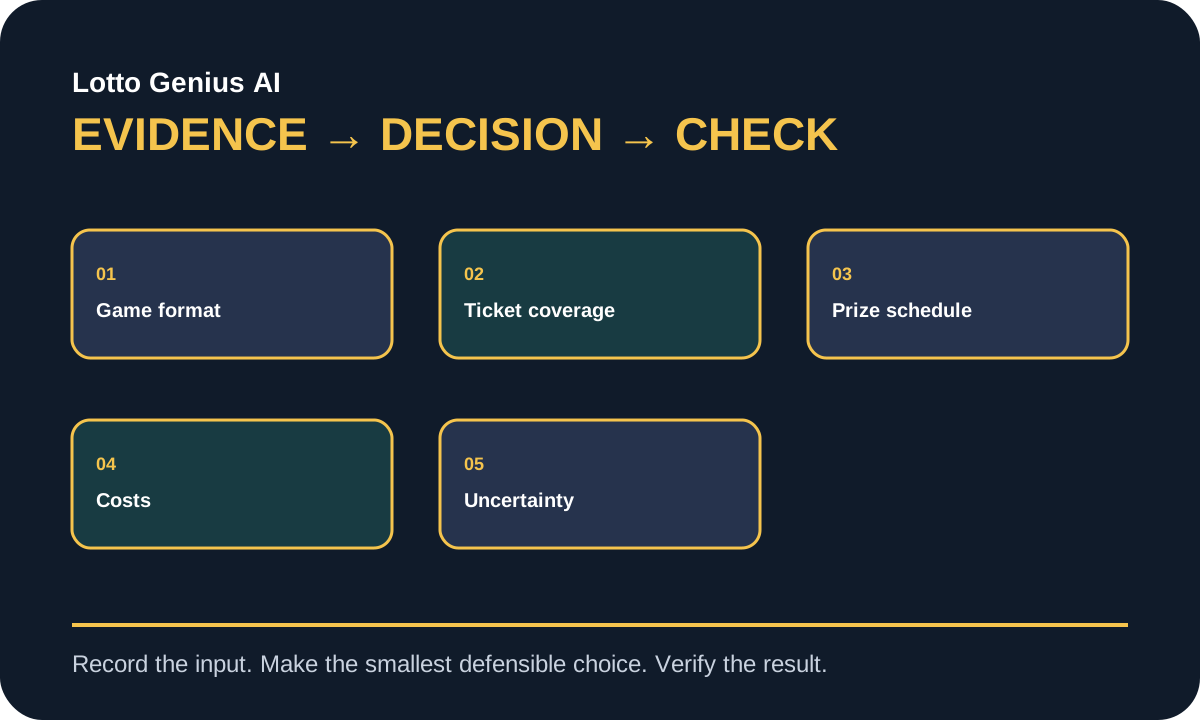
Define the system before judging the result
Lottery probability becomes easier to reason about when every claim is translated into combinations, assumptions and a checkable denominator. A useful definition names what is inside the decision, what remains outside it and which entity owns each attribute. Without that boundary, words such as “accurate,” “accessible,” “large,” “safe” or “high capacity” can quietly change meaning between the claim and the conclusion.
The framework on this page separates an observation from an inference and an inference from an action. That distinction matters because a plausible story can still be unsupported. Record the source, date and scope of each input; identify which value would change the decision; and keep unknowns visible. When a result depends on a current price, rule, business status, weather event or site condition, verify it again at the moment of use. The goal is not perfect certainty. It is a decision that another reader can reconstruct, challenge and update without relying on confidence language.
- Combination
- An unordered selection of items. In a pick-k-from-n lottery, the number of possible tickets is n choose k.
- Sample space
- The complete set of outcomes allowed by the game rules before any ticket is drawn.
- Independent draw
- A draw whose probabilities are not changed by the specific result of an earlier properly run draw.
- Expected value
- The probability-weighted average of possible returns, before considering personal utility or entertainment value.
Use an EAV decision framework
Entity–attribute–value thinking turns a vague topic into checkable fields. The entity is the thing being evaluated; the attribute is the property that matters; the value is the measured, quoted or observed state. Keep units, dates and sources attached to values. The table below is a working decision framework rather than a list of generic tips.
| Variable | Evidence to collect | Decision rule |
|---|---|---|
| Game format | Main numbers, bonus balls, order requirements and replacement rules | Write the rules as a sequence before calculating. |
| Ticket coverage | One line, multiple lines, wheeling system or syndicate share | Count unique combinations rather than printed rows. |
| Prize schedule | Fixed prizes versus pari-mutuel pools | Use the actual tier probabilities and current payout rules. |
| Costs | Ticket price, add-ons, taxes and shared ownership | Compare net outcomes on the same basis. |
| Uncertainty | Unknown future jackpot splits and participation | Report a range instead of a single precise figure. |
Run the workflow in order
Use the sequence below as a small operating procedure. Each step creates evidence for the next, and the final step checks whether the original problem changed. Do not skip directly from a symptom or marketing claim to a purchase. If a required input is unavailable, label the choice provisional and prefer a reversible action. A written sequence also prevents hindsight from rewriting why the decision was made.
- Copy the official game rules and identify which parts of the selection are ordered, unordered, repeated or drawn from separate pools. After completing it, save the supporting note, measurement or confirmation so the next step does not depend on memory.
- Calculate the total number of valid combinations. Check the result with a small toy version of the game that can be enumerated by hand. After completing it, save the supporting note, measurement or confirmation so the next step does not depend on memory.
- Map each prize tier to a probability and payout rule. Keep the jackpot separate when its value or number of winners is unknown. After completing it, save the supporting note, measurement or confirmation so the next step does not depend on memory.
- Multiply each net prize by its probability, add the results, and subtract ticket cost to estimate expected monetary value. After completing it, save the supporting note, measurement or confirmation so the next step does not depend on memory.
- Write down what the calculation does not predict: the next draw, the number of co-winners, taxes and whether buying a ticket is personally worthwhile. After completing it, save the supporting note, measurement or confirmation so the next step does not depend on memory.
Work through a bounded example
Suppose a game asks for six distinct numbers from forty-nine. A player notices that one number has appeared less often in the last fifty draws and calls it “due.” The combination count for the next draw has not changed because of that observation. The useful analysis is to calculate the chance attached to each valid line, verify whether the machine and rules create independent draws, and separate descriptive history from a causal mechanism. If a model cannot name a mechanism that changes the draw process, a frequency chart is not evidence that one line became more likely. This worked example is deliberately bounded: it does not prove that the same answer applies to every property, game, traveler or roof. It demonstrates how entities and attributes become a decision record. A strong record includes the competing options, the limiting constraint, the evidence used, the action taken and the observation that would trigger a revision.
Decision record: write the initial claim, evidence date, limiting constraint, selected action, expected observation and review date in one place. This compact record makes later updates honest and makes the method teachable.
Check predictable failure modes
Most bad outcomes begin with a missing denominator, an unverified current fact, a hidden constraint or a comparison between unequal options. Review these failure modes before the decision becomes expensive or difficult to reverse.
- Failure mode: Treating “not seen lately” as a force that increases a number’s next-draw probability. The repair is to return to the missing input, make it observable and compare the revised choice with the original baseline.
- Failure mode: Comparing jackpot value with ticket price while ignoring the probability of sharing, lower tiers and taxes. The repair is to return to the missing input, make it observable and compare the revised choice with the original baseline.
- Failure mode: Counting duplicate or overlapping system entries as though they were unique coverage. The repair is to return to the missing input, make it observable and compare the revised choice with the original baseline.
- Failure mode: Quoting more decimal places than the payout and participation assumptions justify. The repair is to return to the missing input, make it observable and compare the revised choice with the original baseline.
Verify with primary or authoritative sources
The framework on this page separates an observation from an inference and an inference from an action. That distinction matters because a plausible story can still be unsupported. Record the source, date and scope of each input; identify which value would change the decision; and keep unknowns visible. When a result depends on a current price, rule, business status, weather event or site condition, verify it again at the moment of use. The goal is not perfect certainty. It is a decision that another reader can reconstruct, challenge and update without relying on confidence language. Editorial review on this site favors official rules, government guidance, standards bodies and clearly identified primary documentation. A source supports only the claim it actually addresses; it does not transfer authority to unrelated conclusions.
- National Council on Problem Gambling — consult the current version and jurisdiction-specific guidance.
- NIST Engineering Statistics Handbook — consult the current version and jurisdiction-specific guidance.
Continue through the topic map
Use the related guides to test adjacent assumptions and build a complete decision rather than treating one page as a universal answer.